
Water explainer · Giza Plateau
The Water Would Have Had to Arrive Every Day
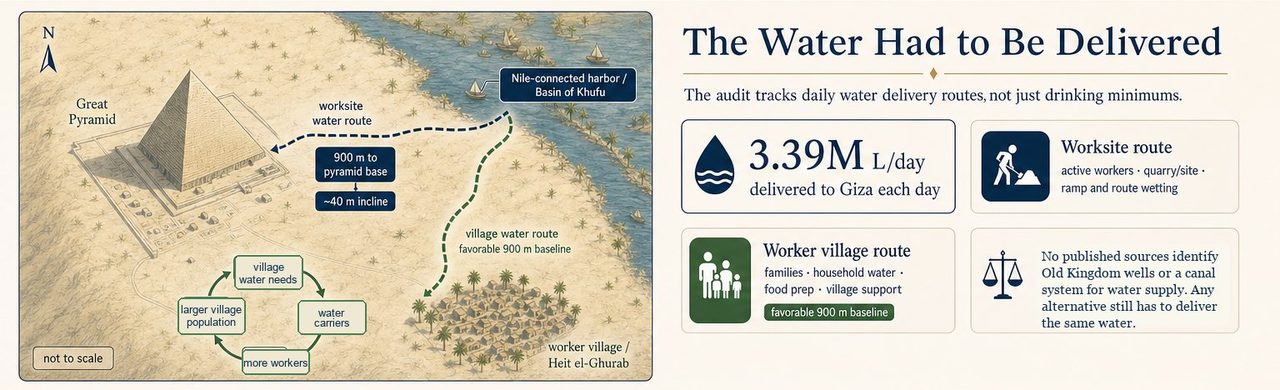
The workers would have needed more than drinking water. Food preparation, village use, and the construction processes in the modeled scenario bring the total to 3.39 million liters delivered each day.
In the published model, delivering that water would have taken 19,960 adults actively carrying it, with 34,695 people in the full workforce needed to keep those jobs staffed. Those carriers would also have needed water and support. The calculation counts their needs too.
Interactive explainer
Build the daily demand
Click each step to see why this modeled water burden grows from a human survival floor into a daily delivery system.
Settlement logic
Why the worker village changes the math
In the model, the village is not a static mouth count. If water delivery requires carriers, those carriers become people the settlement has to support.
- village water needs
- water carriers
- more workers
- larger village population
- more village water
Replacement test
The water still has to reach the workers.
A canal, well, storage tank, animal team, or boat does not deliver water simply by being named. Show where it would have gone, how much water it could have delivered each day, and what it would have taken to build, operate, and maintain it.
If a proposed construction method also changes how much water would have been needed, calculate that change too. Compare the full work of carrying water with the full work of the proposed alternative. Neither gets free workers or free construction.
Model anchors
Where the water total comes from
The headline total is the integrated Giza-delivered water total produced by the workbook’s water system anchor: ModelAnchors_36!B17, controlled by WaterFeedback_21!B32.
Why wells or canals are not assumed here
This page calculates what carrying the water would have required. A different supply system must show where the water would have come from, how it would have reached the people and work that needed it, and how much it could have delivered each day. Count the work needed to build and run that system, then show how many carriers it would have replaced.