
Publication Information
First published: September 8, 2026
Version: 1.0
DOI for this edition: https://doi.org/10.5281/zenodo.22390422
Project website: https://quantifyingantiquity.com/
Public model: https://model.quantifyingantiquity.com/
This paper is the public-facing synthesis of the Quantifying Antiquity system-closure audit. The complete technical analysis, assumptions, source controls, sensitivity tests, and model history are documented in the companion technical report, WP39, https://doi.org/10.5281/zenodo.22392247.
Version status. For corrections, later versions, and the current status of this publication, use the Versions section of the Zenodo DOI record above.
Suggested citation. Quantifying Antiquity. 2026. From Isolated Feasibility to System Closure in the Conventional Great Pyramid Construction Explanation. Version 1.0. https://doi.org/10.5281/zenodo.22390422.
Copyright and license. Copyright © 2026 Quantifying Antiquity. Quantifying Antiquity is the publishing name of the author and an independent research project. This paper is licensed under the Creative Commons Attribution-NoDerivatives 4.0 International License (CC BY-ND 4.0): https://creativecommons.org/licenses/by-nd/4.0/. Attribution should identify Quantifying Antiquity, the publication title, its version, and the DOI. Except where otherwise credited, the license applies to this paper and its original figures. It does not apply to the protected workbook, model source code, private repository, checking software, project name, or branding.
Abstract
Under the operational parameters tested, the conventional construction explanation for the Great Pyramid fails on multiple independent fronts. Labor and settlement demands exceed the historical benchmarks used in the audit. Timber, rope, and copper fail separate supply and production tests. Granite transport fails at bearing, floating transfer, restraint, unloading, and refloat. These failures do not depend on one another, and their effects compound. None can offset another.
Taken together, the required operations do not form a workable construction program. No published study reviewed for this audit makes quarrying, shaping, hauling, ramp operation, tool supply, water, food, housing, maintenance, material replacement, river transport, and granite transfer work together on one schedule within finite labor and material resources and governing physical limits. Existing studies usually test isolated operations. The Great Pyramid was not built one operation at a time.
Quantifying Antiquity performs the missing test. It gives every supported correction its full benefit, carries the resulting requirements through the project, and prevents the same worker, material, or transport capacity from being deployed twice.
At the published population anchor of 1.6 million, active construction requires 47,342 concurrent non-farm prime-age men from a modeled pool of 76,800. That is 61.6% of the available pool and 2.5 times the model’s 25% single-project benchmark. Separately, the staffing rules produce an on-site roster of 47,316; the two figures are independently derived. The workbook reports a settlement overshoot of 11.27 times the 4,200-worker effective-workforce screen on its published cumulative-roster basis. The corrected-basis derivative recorded in Methods Ruling MR-21 lowers the overshoot to 8.35 times. The settlement finding is unchanged.
The material findings do not depend on the population estimate. Timber throughput reaches 30.09 times the volume represented by Snefru’s recorded forty-ship cedar delivery. Annual rope replacement reaches 567.2 metric tons. Quarry-tool copper requires 7.16 times Bir Nasib’s estimated long-run average annual output and consumes 11.01% of the site’s estimated total metallic production recorded across roughly 1,300 years.
Granite transport fails at both ends of the river route. Loading an 80-metric-ton beam moves the modeled vessel’s deck edge 0.410 meters, 4.10 times the stated tolerance. Break-even requires 3,200 square meters of effective waterplane, equivalent to a 246-meter hull at the modeled beam. Grounding the vessel removes the floating instability but creates bearing, restraint, unloading, and refloat requirements that the conventional explanation does not solve.
The audit determines that Old Kingdom Egypt did not possess the capability required to deliver the Great Pyramid. The finding stands unless the published evidence or calculations are broken at a load-bearing point or the governing physical thresholds are met. Until then, the conventional explanation continues to fail the audit.
Executive Summary
Mainstream Egyptology generally explains the Great Pyramid as an Old Kingdom state-directed construction project carried out by a large labor force using copper tools, ropes, sledges, ramps, and Nile transport. This paper refers to that account as the conventional construction explanation. Archaeology documents the physical record; experimental archaeology and engineering studies test individual operations. The audit finds independent failures in labor and settlement, timber supply, rope production, copper supply, and granite transport. It also finds that the required operations cannot all be performed and sustained together within the same schedule, resource base, and physical limits.
The model turns the conventional explanation into a project plan and tests whether it can run. Every required operation must fit the schedule, remain within physical limits, and draw from the same finite labor and material base. No resource can be deployed twice. A required operation does not disappear merely because the published explanation supplies no working method.
This is not a competing construction hypothesis. The audit tests the conventional explanation on its own evidence, evaluates published construction mechanisms within their stated boundaries, makes the assumptions used to assemble them explicit, and carries every resulting requirement through the complete construction system.
The labor case fails independently of the material and physical findings. Active construction requires 47,342 concurrent non-farm prime-age men from a modeled national pool of 76,800. That commits 61.6% of the available pool to one project and exceeds the model’s single-project benchmark by a factor of 2.5. Separately, the staffing rules produce an on-site roster of 47,316. It is 11.27 times the 4,200-worker settlement screen on the workbook’s published cumulative-roster basis and 8.35 times the screen in the corrected-basis derivative recorded in MR-21.
The material findings establish separate failures that a larger population cannot repair. Cumulative timber throughput reaches 30.09 times the largest documented timber delivery used in the audit. Even after half the requirement is assigned to domestic sources, imported timber alone remains 15.05 times that delivery. Annual rope replacement reaches 567.2 metric tons. Quarry-tool copper requires 7.16 times Bir Nasib’s estimated long-run average annual output.
The granite route fails at loading and unloading. Loading an 80-metric-ton beam moves the modeled vessel’s deck edge 4.10 times the stated tolerance. Holding that movement to the tolerance requires 3,200 square meters of effective waterplane. Grounding the vessel avoids the floating instability but creates a different failure: the loaded hull must bear on the river margin, remain controlled, release the beam, and return to navigable water. The conventional explanation supplies no complete working method for that operation.
No correction to one failure resolves another. More workers do not create the missing material or physical capacity. A larger vessel does not resolve the labor and supply failures. A longer schedule lowers annual production but extends maintenance, replacement, and support across additional years.
The conventional explanation does not survive the audit. The audit determines that Old Kingdom Egypt did not possess the capability required to deliver the Great Pyramid. Reversal requires evidence that clears every governing threshold or a complete construction program that supplies every required mechanism and carries its consequences through the same schedule and resource base.
1. Introduction
No large construction project can be shown to work by testing its operations one at a time. The Great Pyramid is no exception.
Egyptology has never demonstrated that the conventional construction explanation can pass a complete engineering audit. Archaeology documents the material evidence. Experimental archaeology tests individual operations. Engineering studies test forces, materials, and particular mechanisms. Several major operations fail on their own, and the required operations cannot all be performed and sustained together within the same schedule, resource base, and physical limits.
Quantifying Antiquity turns the conventional explanation into a resource-loaded project and tests whether every required operation can run within the same schedule, finite resources, and physical limits.
The model begins inside the conventional explanation. Its chronology and construction conditions define the scenario being tested; they are not findings of the audit. A favorable assumption receives its full benefit, but every requirement it creates remains in the model.
The model also separates findings governed by different evidence. A change in population can alter the labor result. It cannot create a material supply, enlarge a vessel’s waterplane, stabilize a loaded hull, or supply a missing heavy-load transfer method. That separation prevents one favorable assumption from being used to reverse an unrelated failure.
This paper presents the missing execution test, the rules that govern it, and the evidence required to reverse its findings. Several results independently establish that Old Kingdom Egypt did not possess the capability required to deliver the Great Pyramid.
2. From Individual Feasibility to System Closure
2.1 The analytical gap
Published Great Pyramid studies commonly divide construction into separate technical problems. Quarrying, shaping, overland hauling, river transport, lifting, setting, surveying, and workforce requirements are analyzed within different boundaries. Dividing complex work into manageable parts is necessary. The analytical failure begins when the results are not reconnected and tested as one project against the same schedule, finite resources, physical interfaces, and support requirements.
A hauling experiment can establish the crew required to move a block under stated conditions. The project-scale question also requires the number of teams needed to maintain output, the rope and sledge replacement stream, route traffic, surface maintenance, wetting water, food, housing, supervision, and the competing demands placed on those same workers elsewhere.
A vessel reconstruction can establish hull dimensions and displacement. Delivering an 80-metric-ton beam also requires the vessel to float its own hull and the complete operating load, a working loading method, deck-edge stability, restraint, and unloading. If grounding is proposed, the operation also requires adequate ground bearing and a means of refloating the laden vessel.
A ramp model can establish geometry and a block-placement schedule. It does not establish ramp construction, maintenance, removal, traffic support, working surfaces, water supply, replacement materials, and labor required to keep the ramp operating at the stated rate.
Published engineering studies have proposed rockers, lever-assisted lifting, reduced-friction hauling, and other improvements to individual operations. Some have been demonstrated at limited scale. A limited demonstration does not become a project solution until its required quantity, materials, fabrication, labor, operating rate, maintenance, replacement, logistics, and support are defined and carried through the complete construction program.
A proposed improvement receives full credit wherever it reduces a measured requirement, but only within the functions it actually changes. If it reduces the hauling crew, the connected food, water, housing, and household-support demands fall with it. It does not reduce shaping labor, quarry-tool copper, timber replacement, granite loading, or unloading unless it changes those requirements too. A faster lifting method may reduce lifting labor, but it cannot increase total project output unless quarry production, delivery, working space, traffic capacity, and setting operations can sustain the higher rate. Any new equipment, infrastructure, fabrication, maintenance, or support created by the improvement must also be counted.
2.2 The Integrated Edge-Ramp model
Rosell Roig’s 2026 peer-reviewed Integrated Edge-Ramp study provides a bounded source module for the audit: the ramp geometry and traffic schedule used in the principal haulage case. It couples parametric geometry, discrete-event logistics, and staged finite-element analysis and concludes that an adaptive multi-ramp schedule can sustain the required block cadence within the construction window tested by that study. Rosell Roig published the complete code and datasets, making the geometry, logistics, structural results, and traffic record available for reproduction and audit (Rosell Roig 2026).
This analysis is an independent system-closure audit of the conventional Great Pyramid construction explanation. It uses published findings, parameters, and model outputs from multiple sources. Those source inputs retain their original attribution. The assumptions introduced here, and the resulting derived requirements, integrated calculations, and conclusions, are the work of Quantifying Antiquity.
The Integrated Constructibility Model uses the IER study’s published geometry, lane configuration, friction basis, dispatch logic, phase transitions, block-placement schedule, and staged structural response under self-weight. The analysis treats the IER ramp as one work package within the complete construction system. The Integrated Constructibility Model uses the version-specific v1.0.14 public data deposit, DOI 10.5281/zenodo.20615955.
The IER paper also includes high-level allowances for planning, quarrying, river transport, seasonal interruption, and granite handling. Those allowances do not define complete resource-loaded operations or count their full labor, materials, infrastructure, maintenance, replacement, and support. The connected work packages are therefore constructed from their own evidence and engineering relationships. A ramp schedule that meets its modeled block cadence does not by itself establish project closure.
2.3 Dependency architecture
The model connects construction activities and support functions that are normally analyzed separately across scheduling, estimating, logistics, materials management, workforce planning, demography, operations research, and engineering. Each dependency identifies the quantities it affects and carries those changes through the rest of the construction system.
Changing the construction duration changes the required production rate, standing labor, replacement cycles, food and water demand, household support, ramp maintenance, material consumption, and the number of years the support system must remain in operation. A replacement method changes only the requirements it actually affects, while its own labor, materials, fabrication, infrastructure, maintenance, and support enter the same dependency chain. Every dependency is explicit, so a changed input updates every affected requirement.
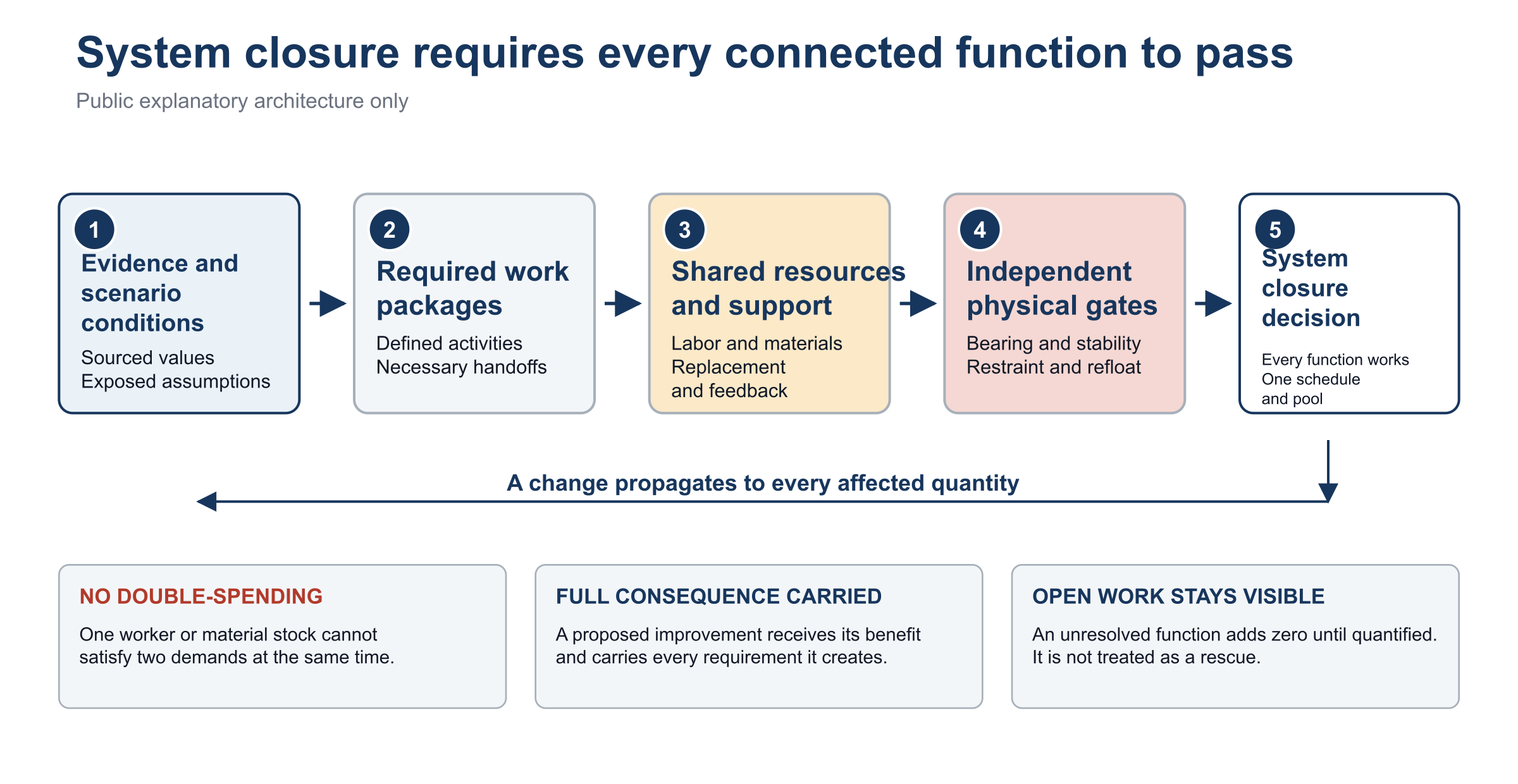
Figure 1. The audit converts separately studied construction operations into one resource-loaded program. A change receives credit wherever it reduces a requirement, but every resulting labor, material, infrastructure, maintenance, replacement, and support demand remains in the same system. Physical gates must pass independently of labor and population assumptions.
Source: Quantifying Antiquity research report v1.0, Sections 2.3 and 5.1-5.7; White Paper v3.9 (wp39), Sections 3-6. Conceptual relationships only. No protected workbook formulas or private dependency architecture are shown.
3. Scope, Boundary, and Claim
The model tests the conventional Great Pyramid construction explanation as a complete construction system. The capability result does not depend on who built the pyramid, its original purpose, or whether an alternative construction method exists. Those questions do not alter the technical requirement: the conventional explanation must satisfy every function required to build the pyramid.
The scenario uses the chronology and construction conditions supplied by the conventional explanation. It assumes a large Egyptian workforce, copper tools, ropes, sledges, ramps, Nile transport, the published population estimate used for the principal case, and a construction period of approximately 20 to 30 years.
The modeled boundary includes:
- quarrying, rough dressing, final shaping, fitting, setting, alignment, and rework;
- stone haulage, ramp operations, route wetting, traffic, maintenance, and removal;
- rope inventory, service life, replacement, fiber production, and rope manufacture;
- copper-tool inventory, wear, mining, smelting, charcoal production, and replacement;
- structural timber, ramp planking, sledges, levers, cribbing, anchors, workshops, and granite vessels;
- water delivery, carrier feedback, food production, agricultural households, and off-site support;
- on-site and off-site workforce, roster coverage, households, mortality, workforce replacement, and settlement;
- the Aswan-Giza granite corridor, vessel crews, harbors, pilotage, loading, unloading, restraint, ground bearing, and refloat requirements; and
- demographic, agricultural, settlement, material-supply, and state-capacity comparisons.
Sanitation and basic medical support; processing, fuel, and containers; administration, security, and lighting; and parts of route-capacity analysis remain open or diagnostic. Their treatment is stated in Section 10.3.
The audit determines that Old Kingdom Egypt did not possess the capability required to deliver the Great Pyramid. Reversal requires evidence that clears every governing threshold or a fully defined construction program that supplies every required mechanism and carries its labor, materials, infrastructure, maintenance, time, and support through the same finite resource base.
4. Evidence Base
4.1 Project geometry, cadence, and construction sequence
Published dimensions, masonry volume, block-count estimates, block-mass distributions, and course geometry, together with the construction window used in the principal scenario, define the production requirement tested. The IER study supplies the ramp geometry and traffic record used for the principal haulage case. Its open dataset provides the block-placement schedule and total loaded hauling distance, expressed in sledge-kilometers, from which surface wear and ramp-planking replacement are calculated.
Under that scenario, the required cadence is approximately 206 blocks per working day. Maintaining that output requires approximately 63 simultaneous haul teams and about 55 blocks moving through the haulage system at one time. These are operating quantities, not total workforce figures. Roster coverage and support functions are added separately.
4.2 Workforce organization and river transport
The Diary of Merer, published by Tallet from the Red Sea papyri, documents phyle and gang structure, rotation, cargo movement, river operations, and administrative control. The model uses it to define crew organization and count labor by role and function. It anchors phyle size, voyage cadence, and harbor operations. Archaeological and geoarchaeological studies provide the harbor geography and topographic context (Lehner 2020; Younes et al. 2024). The Aswan-Giza distance is a separate geographic input corroborated by Hemeda and Sonbol (2020).
The model grants an eight-vessel heavy-barge fleet and calculates the river organization required to move all 8,000 metric tons of Aswan granite. At one 80-metric-ton design load per voyage, the full mass requires 100 voyages and 3.79 150-day fleet-seasons. The additional voyages extend the operating duration of the same fleet; they do not require more concurrent crews unless the schedule is compressed. The standing river organization consists of 557 rostered barge crew, 140 harbor and dock personnel at both ends, and 46 pilotage personnel, for 743 rostered personnel in total. These personnel enter the model as bodies only, without household multipliers. This result establishes only that the voyages fit the modeled navigation window and that the river workforce has been counted. It does not provide the vessels or solve loading, deck stability, restraint, unloading, grounding, refloat, or repair.
4.3 Population, agriculture, and settlement
Butzer’s published figure of 1.6 million provides the principal population anchor. Butzer labels the underlying table hypothetical, so the audit treats the figure as a stress-test denominator, not as a confirmed population count. The 2.0 million case is retained as an out-of-period favorable stress test, and the 2.5 million case as a later-era extreme. Neither is presented as part of a defensible Old Kingdom population range (Butzer 1976, 83, table 4).
The model assumes that prime-age men equal 24% of the population and reserves 80% of that cohort for the agricultural labor required to sustain the kingdom. The 24% share is taken high in the conventional explanation’s favor; the 80% agricultural reserve is taken low for the same reason. Both are exposed assumptions. The sensitivity analysis varies population, prime-age share, and agricultural reserve together.
The Heit el-Ghurab excavations and published worker-settlement studies provide the basis for the settlement comparison. The model uses 25,000 people as a deliberately generous capacity screen, well above the published excavated-capacity arithmetic for the worker town. The screen tests the physical settlement evidence without assuming that every project worker occupied one bounded settlement (Lehner 2002; Lehner 2015; Redding 2013).
Agricultural calculations use grain yield, household consumption, seed and storage, land overhead, farmer productivity, and surplus assumptions. The direct-cropland lower bound remains the headline food method. The feedback-solved farmer-household calculation is reported as the named ceiling. Together they bracket the food burden under a fixed reporting rule: the lower bound controls the headline, and the feedback-solved case remains visible as the ceiling.
4.4 Material comparators
The Palermo Stone record of 40 cedar ships under Snefru provides the timber-delivery comparator. The ship count is sourced; the modeled per-ship volume of 68.625 cubic meters is an assumption set high to favor the conventional scenario. The resulting comparator volume is 2,745 cubic meters. The record supplies the largest documented single delivery used in the analysis. Egypt's maximum timber-import capacity remains undetermined (Wilkinson 2000, 141-145).
Bir Nasib provides the principal copper comparator. Abdel-Motelib et al. (2012) report a 5,000-metric-ton metallic-copper estimate that they attribute to Bachmann; they do not identify the calculation's primary publication. The workbook therefore classifies the comparator as medium-confidence and leaves primary-source verification open. The audit nevertheless uses the full estimate and roughly 1,300-year operating span, most of it later than the chronology supplied by the conventional explanation. This grants the conventional explanation a much larger denominator than an Old Kingdom-only comparison would provide.
Rope output is compared with the sourced rope requirement for a complete first-rate sailing-ship rig. The comparison with the Ropery at Chatham is secondary because its production and workforce inputs do not rest on equivalent primary evidence. The reportable finding therefore rests on the first-rate rigging comparison; the Chatham figures are used only for scale.
The granite vessel comparison uses a reconstructed New Kingdom obelisk barge at 63 by 21 meters, producing 1,323 square meters of maximum box waterplane. The vessel belongs to a period long after the chronology supplied by the conventional explanation, and the reconstruction is contested. It is used only as a magnitude comparison. No published conventional explanation supplies the 3,200-square-meter waterplane required to pass the loading test.
4.5 Human and physical-performance evidence
Experimental archaeology, published quarry trials, friction studies, physiological work limits, regional labor calendars, tool-wear evidence, timber conversion, material service life, and geotechnical and hydrostatic calculations supply the remaining engineering inputs. Inputs are classified as sourced, derived, assumed, controlled, or open. Assumption depth is reported because an output derived through two relationships does not carry the same confidence as one derived through eight successive assumptions.
5. Method
This section explains how the model turns evidence about separate construction tasks into one testable construction program. Each method addresses a recurring problem in the conventional explanation: required work disappearing between broad stages, totals being compared across incompatible time periods, shared resources being used more than once, proposed solutions receiving credit without their consequences, and missing mechanisms being treated as if more labor could resolve them.
5.1 Resource-loaded work breakdown
A work breakdown structure (WBS) divides a project into defined activities and the supporting work each activity requires. It prevents necessary functions from disappearing between broad descriptions of quarrying, transport, lifting, and placement. The model is organized as a WBS in which each modeled construction activity is connected to the labor, materials, infrastructure, maintenance, replacement, and support required to sustain it.
Direct labor is expanded to the number of people required after availability, rotation, rest, and mortality replacement are applied. That staffing requirement is kept separate from household and dependent population. On-site workers are also separated from off-site production and support committed to the construction program.
Construction demands occur on different time bases. The model therefore distinguishes the workforce required during a specific operating period from the total number of different people who serve over the project life cycle. The workforce required during a given period is compared with the labor pool available during that period. The total number of people who cycle through those positions is compared with the number of eligible workers who become available across the same years.
Materials are treated the same way. Stock required in active service, material replaced each year, and total consumption across the project life cycle remain separate quantities. This prevents a requirement accumulated over twenty years from being compared with a supply available at only one specific time.
5.2 System-closure rule
System closure means that every indispensable construction function has a working method and that the complete set of methods can operate within the same schedule, resources, and physical limits. A schedule can fit within the stated construction period while the supporting system fails. A population estimate can appear sufficient while a required loading operation remains physically unresolved.
The model therefore requires every proposed mechanism to carry its labor, materials, infrastructure, maintenance, replacement, and support. The construction explanation closes only when every governing requirement passes.
5.3 Material balance and no double-spending
Material balance means that the same finite resource cannot perform two jobs at once. A worker committed to one operation is unavailable to another unless additional labor is supplied. Timber burned as fuel cannot remain in service as ramp planking. Grain committed to construction households cannot also remain available to the rest of the kingdom. Soldiers assigned to barges remain part of the same finite non-farm male labor pool.
The model applies this rule to every finite resource it carries, including labor, food, water, timber, rope, copper, fuel, agricultural output, containers, transport, and administrative capacity.
5.4 Required-function audit
A required-function audit asks whether a proposed change still performs the job supplied by the original resource or method. Removing a burden from a calculation does not remove the physical function that created it.
Replacing water carriers with canals, wells, boats, animals, depots, or cisterns can reduce carrying labor, but the replacement introduces construction, materials, containers, operation, maintenance, and labor of its own. Extending timber life reduces replacement demand but does not remove the timber that must remain in service or the work required to maintain it. Increasing productivity can reduce direct labor while changing production rate, working space, supervision, tool use, maintenance, and support.
A proposed change receives its measured benefit. Its full requirements remain in the model.
5.5 Feedback treatment
Feedback occurs when a support function creates additional demand for the same support it supplies. It is essential because the first estimate is not necessarily the final requirement. If the people added to solve a problem also consume the resource being supplied, stopping at the first estimate understates the operation.
Water delivery demonstrates the principle. Water carriers consume water themselves. Their households add further demand. Meeting that added demand requires more carriers, who add still more people and consumption. The water module solves that loop algebraically until the additional carriers and the demand they create are fully counted.
Food is tested under two fixed methods. The direct-cropland method calculates the farmers and agricultural output required to feed the construction population and supplies the lower reported result. The farmer-household method also carries the food required by the producers and their households. That additional demand requires further production, which is repeated until the loop stabilizes.
These are not competing methods selected after their results are known. One is the fixed lower treatment and the other is the fixed upper treatment. Together they show the range between the direct food requirement and the burden produced when agricultural households are carried through the feedback loop. Their results are reported in Section 6.
5.6 Material stock, service life, and replacement
Service-life accounting distinguishes what must exist from what must be replaced. A material may require only a modest quantity in active service while creating a much larger production burden when wear, damage, loss, repair, and replacement continue across the project life cycle.
The model therefore separates active stock, spare stock, annual replacement, and total consumption. This treatment applies to rope, timber, sledges, tools, working surfaces, and vessels. Traffic and wear determine how often those materials must be repaired or replaced.
Timber is carried on the felled basis when compared with delivered raw timber. Conversion loss, structural rejection, handling loss, and water damage occur after the trees are felled and therefore remain part of the procurement requirement. At the current settings, only 38.61% of the felled input becomes usable material.
5.7 Physical capability gates
A physical capability gate is an engineering requirement that additional labor cannot resolve. Where the conventional explanation supplies no demonstrated working mechanism, the model states the physical requirement or break-even threshold instead of inventing equipment to fill the gap. This makes the missing capability measurable and establishes exactly what evidence or mechanism would reverse the finding.
At Giza, the bearing-pressure test determines the minimum ground-contact area a loaded lifting system must provide. At the vessel, the hydrostatic test calculates how far the deck edge moves while the granite beam is being loaded or unloaded. Separate tests calculate the required restraint force and the requirements created by grounding, refloat, and mid-route repair.
These are not optional refinements. Every required gate must pass for a granite beam to complete the route. If loading, unloading, stability, restraint, bearing, or refloat fails, the river journey does not deliver the stone.
5.8 Concessions, sensitivity, and counting basis
A concession deliberately selects an assumption favorable to the conventional explanation where the evidence permits a range. Sensitivity testing then changes exposed assumptions across defined ranges to determine whether a finding depends on one selected value.
The demographic concessions include the 1.6 million population anchor with higher values tested, a high prime-age share, and cases with a reduced agricultural reserve. Production concessions include grain as the least land-intensive calorie source, complete copper recovery and recycling except quantified unrecoverable loss, generous water-carrier productivity, wetting only the loaded haul lane, and a 50% native-timber allowance. Granite concessions include a box-shaped hull approximation that maximizes waterplane, a reduced heavy-beam subset, an eight-vessel heavy-barge fleet, and the exclusion of disabling injury from worker replacement.
The audit also tests whether cumulative staffing totals have been placed on the same time basis as daily consumption. A cumulative workforce count includes every person who serves during the project, including replacements. Daily water and food demand depends on the people present during a given period, not everyone who serves across the project life cycle.
Version 0.92 retains the cumulative-roster basis in its published settlement and broader-population calculations for traceability. Methods Ruling MR-21 records two recalculated derivatives measured before a full re-basing was rejected as cost without benefit. The settlement overshoot falls from 11.27 times to 9.86 times and then 8.35 times, and the broader project population falls from 533,234 to 403,746. These derivative values are recorded in the ruling, not in live output cells. The labor, demographic, and settlement findings survive both derivatives. Timber, rope, copper, and granite are governed by production rates and physical thresholds that the counting basis does not affect. The higher cumulative basis therefore does not control any conclusion.
Mobilization means the share of the available national labor pool kept committed to one program over time. The model uses 25% as an exposed single-project comparison, not as a documented historical ceiling. At the 1.6 million population anchor, the construction program directly requires approximately 61.6% of the available non-farm prime-age male labor pool. Removing the 25% comparison does not remove that demand.
6. Results
The results move from the people and support the construction program would have to sustain, through the materials it would have to replace and deliver, to the physical operations required to move the granite. Each finding tests a different requirement. The workforce must be available and maintained. It must be housed, fed, and supplied with water. Timber, rope, and copper must arrive at the required rate. The granite beams must still be loaded, carried, unloaded, and placed. Failure of any required function is enough to break the construction explanation. Several fail independently.
6.1 Labor left after agriculture
The controlling labor question is how much of the kingdom's non-farm male workforce the construction program would require while the army, administration, temples, trade, other construction, and every other state function remained staffed.
The population anchor produces 384,000 prime-age males. Reserving 80% for agriculture leaves 76,800 for all non-farm state functions. The model requires 47,342 non-farm men during active construction. The Great Pyramid program therefore consumes 61.6% of the entire available pool, approximately 2.5 times the model's 25% benchmark for a single project.
The comparison remains 61.6% under both valid time bases. The workforce required during active operations is compared with the workforce available at that time. The total number of men who must cycle through those roles across the project life cycle is compared with the total eligible cohort produced across the same period. The earlier comparison between a project-life total and a point-in-time workforce is retained only as a transparency line and does not control the finding.
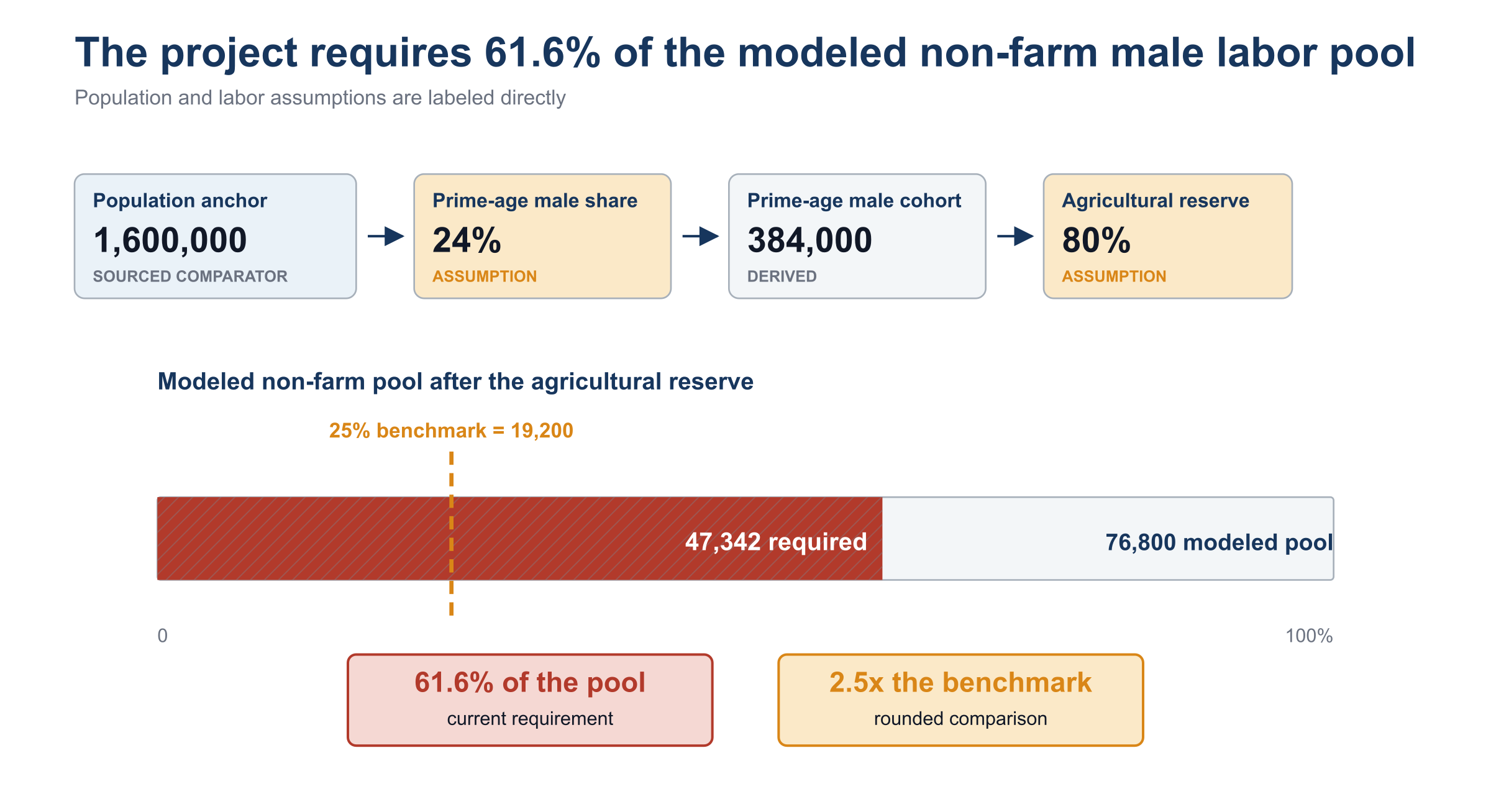
Figure 2. At the 1.6 million population anchor, the exposed 24% prime-age male share and 80% agricultural reserve produce a modeled non-farm pool of 76,800. The concurrent project requirement of 47,342 is 61.6% of that pool and approximately 2.5 times the stated 25% benchmark.
Source: Research report v1.0, Sections 4.3 and 6.1; White Paper v3.9 (wp39), Section 9.1 and Finding F24; reported model references NationalClosure_41 and ClosureSensitivity_45. The 1.6 million anchor is a sourced historical comparator; 24%, 80%, and 25% are assumptions or project comparisons; the pool and ratios are derived.
6.2 A workforce renewed for decades
A workforce of this scale would not be raised once and then remain unchanged. Death, injury, aging, and ordinary turnover would require the state to replace part of it every year for the full construction period.
The standing non-farm workforce equals 12.3% of the national prime-age male cohort. Maintaining it requires approximately 2,705 additional prime-age males to enter the project each year, also 12.3% of every maturing male cohort. That demand continues across the full 20-to-30-year construction period.
Weni's levy is the largest mobilization documented for the Old Kingdom and is read here at a generous maximum of 50,000. The project workforce equals 0.95 times that levy at the default mortality setting. Across the sourced mortality range from the Giza worker cemetery, it ranges between 0.825 and 1.140 times the levy (Lichtheim 2006, 18-22).
The difference is duration. Weni's force was an episodic national mobilization, reinforced by foreign auxiliaries, raised for military campaigns, and then disbanded. The construction program requires a workforce of the same order to be maintained and renewed from the domestic non-farm population for decades.
6.3 Feeding and watering the workforce
The labor requirement expands when the people needed to feed, supply, and support the workforce are carried into the calculation. Those support workers also consume food and water, creating further demand.
The model requires 47,316 on-site positions after the staffing rules are applied. Using the stated settlement and household structure produces an implied on-site population of 281,643. Off-site project-dedicated production and support add 250,848 people, while the river and harbor organization adds 743 personnel without resident-family multipliers. Under the lower direct-cropland food treatment, the resulting population footprint is 533,234 people, or 33.33% of the 1.6 million population anchor. The alternate feedback-solved farmer-household treatment produces 1,603,797 people, exceeding the population anchor itself.
These population totals include dependents who existed independently of the project, so they do not replace the governing non-farm labor test. They show the scale of the population that must be provisioned for the construction program to operate.
Under the direct-cropland method, the project food chain requires 45,282 farming households. Including their dependents, 226,410 people enter that chain before the on-site workforce is counted. This equals 14.15% of the kingdom. No surviving record establishes a formal pass-or-fail ceiling for the share of national agricultural output available to one construction program, so this result establishes magnitude rather than a separate hard threshold.
Water delivery reaches approximately 3.39 million liters per day. The initial calculation requires 1,471 active adult carriers. Once the water consumed by the carriers and their households is included, the requirement rises to 19,960. Of those carriers, 18,489 are created by the feedback itself. An alternative delivery system could reduce that labor, but only after its construction, operation, maintenance, materials, and support requirements are defined and counted.
6.4 Housing and supporting the workforce
The settlement test asks whether the known accommodation evidence is commensurate with the workforce the construction program requires.
The model requires 47,316 on-site positions. This roster is derived under the staffing rules and is not the independently calculated 47,342 concurrent non-farm labor requirement. The settlement evidence supports an effective-workforce screen of 4,200. On the workbook’s published cumulative-roster basis, the required workforce is 11.27 times the screen. The corrected-basis derivative recorded in MR-21 lowers the overshoot to 8.35 times, and the finding remains unchanged. Break-even requires effective-workforce capacity for 47,316 workers, equivalent to 281,643 implied residents under the same household multiplier, against a 25,000-person settlement screen. Because the multiplier appears on both sides and cancels, the controlling comparison remains the workforce requirement against the 4,200-worker screen.
A distributed-settlement proposal would not erase the requirement. It would have to provide housing, food, water, waste control, circulation, storage, administration, and transport for the same workforce across multiple locations.
6.5 Timber delivery across the project life cycle
The timber finding concerns sustained replacement and delivery. The construction program does not need the timber once. Structural members and ramp planking must be supplied, worn out, and replaced across the project life cycle.
The structural and IER ramp-planking streams require 4,130.5 cubic meters of felled timber each year, excluding timber for the granite barges. Across a 20-year build, the requirement reaches 82,609.5 cubic meters.
The Palermo Stone records a 40-ship timber delivery under Snefru. Expressed in the volume represented by that delivery, the project requires 60.19 ship equivalents every year. That is 1.50 times the entire recorded delivery annually and 30.09 times that delivery across the build. This comparison includes both native and imported timber and measures total throughput, not literal imported shiploads.
The imported requirement is reported separately. Under the model's favorable assumption that half of the timber is supplied domestically, imported cedar still requires 30.09 shiploads per year. That is 0.75 times the recorded delivery every year and 601.9 shiploads across the build, or 15.05 times the record.
Doubling the modeled plank service life can bring annual throughput below the 40-ship comparison. It does not eliminate the cumulative delivery burden, which remains 17.48 times the recorded delivery across the build. The Palermo entry is a scale comparison rather than a formal capacity ceiling, but no evidence demonstrates sustained timber delivery at the required cumulative scale.
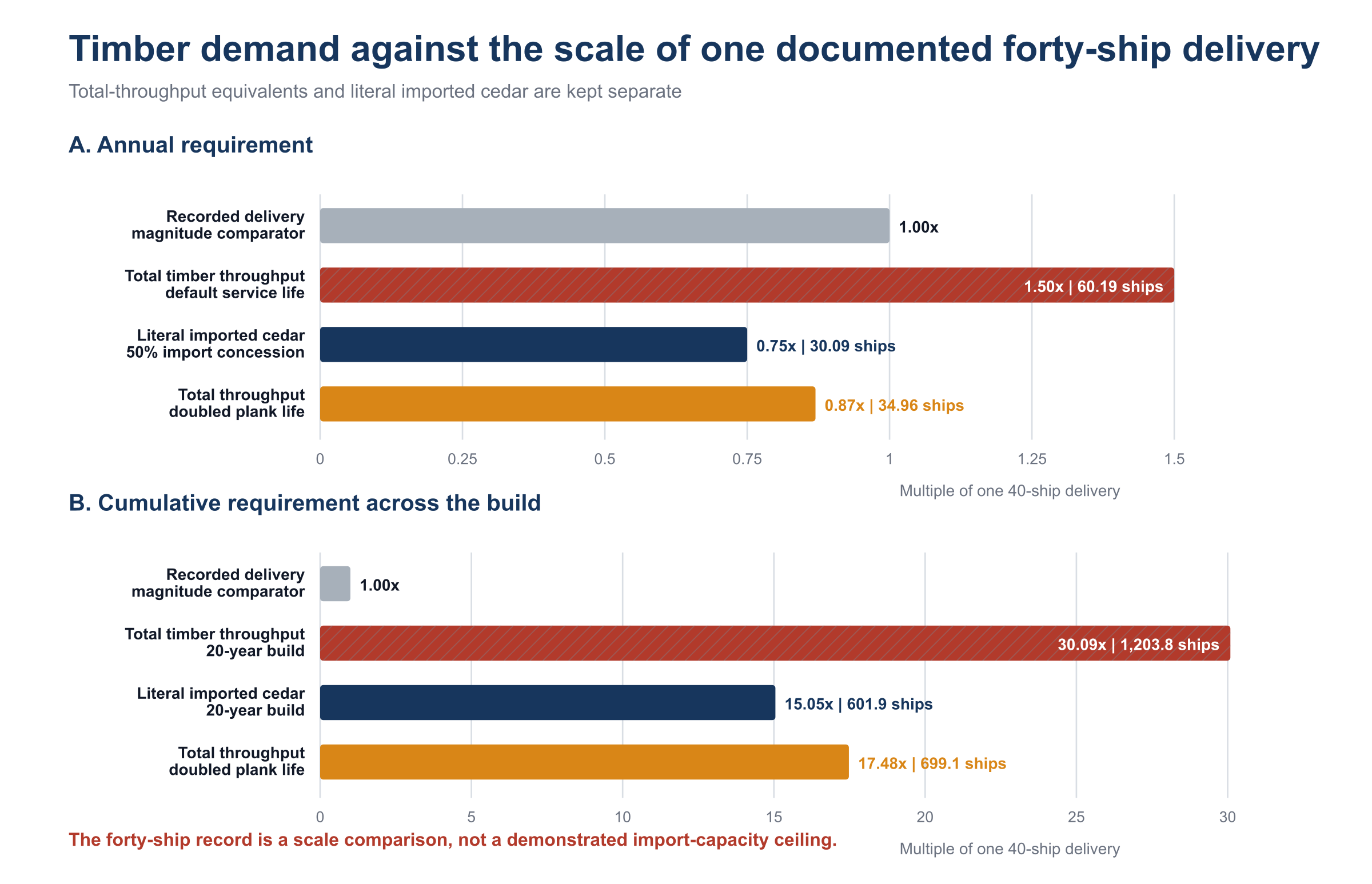
Figure 3. Total timber throughput and literal imported cedar are shown separately. Under the default service life, total throughput equals 1.50 forty-ship deliveries per year and 30.09 across the build; the literal 50% imported-cedar concession equals 0.75 per year and 15.05 across the build. Doubling plank life lowers the annual comparison to 0.87 while the cumulative comparison remains 17.48.
Source: Research report v1.0, Section 6.5; White Paper v3.9 (wp39), Section 10.2 and Finding F27; reported model references TimberLabor_40 and SensitivityBreakEven_06. Forty ships are sourced; 68.625 cubic meters per ship and the 50% imported-cedar share are assumptions. The forty-ship record is a magnitude comparator, not a demonstrated import-capacity ceiling.
6.6 Rope replacement as continuous production
Rope appears modest when measured only by what must be in use at one time. Its short service life turns that stock into a continuous production requirement.
The haulage system requires 13,230 meters of rope in active service and 15,214.5 meters when staged replacement stock is included. At the modeled seven-day service life and production loss, the project must manufacture 872.7 kilometers, or 567.2 metric tons, of finished rope every year. Across the build, total production reaches 11,344.6 metric tons.
That annual output is equivalent to the complete rigging of 17.45 first-rate sailing ships every year, or one complete rigging every 2.98 weeks for the entire construction period.
Finished rope is only the end of the production chain. Annual output requires approximately 667 metric tons of prepared fiber, 2,224 metric tons of raw plant harvest, 1,602 hectares of dedicated fiber cropland, and the farmers, processors, transport workers, and households required to sustain it.
Finished-rope tonnage is the governing finding. The agricultural and labor consequences depend on additional assumptions and are therefore reported at lower confidence. Where those workers already appear in the project workforce, they are not counted again.
6.7 Copper lost through tool wear
Copper tools can be recycled, but recycling does not recover metal lost through wear. That continuing loss requires new copper to enter the project every year.
Quarry cutters and rough-dressing masons require 27.54 metric tons of new copper production annually after supply-chain loss, against a circulating tool inventory of only 3.40 metric tons. Across a 20-year build, the requirement reaches 550.7 metric tons. Final shaping, fitting, setting, casing, and rework add another 1.3797 metric tons per year, but that diagnostic is excluded from the reported comparison.
The quarry-tool requirement is 7.16 times Bir Nasib's estimated long-run average annual output. One construction program consumes 11.01% of the site's estimated total production recorded across roughly 1,300 years. It compresses approximately 143 years of average production into a 20-year build.
That comparison is already favorable to the construction explanation. Much of Bir Nasib's recorded production occurred later, so its all-period total overstates the copper available from that source during the period assigned to the project.
Copper production also requires approximately 344.2 metric tons of ore, 413.1 metric tons of charcoal, and 2,753.7 metric tons of wood each year. The smelting wood enters the shared wood-fuel calculation and cannot be assigned a second time to another requirement.
6.8 The granite route fails at the physical interfaces
The granite result changes the question from the scale of supply to whether the required operations can physically occur. The river timetable can fit within the construction calendar after an eight-vessel fleet and its operating organization are granted. The 80-metric-ton beam must still be loaded, carried, unloaded, and, if the vessel is grounded, refloated. Those interfaces fail.
At Giza, a lifting system operating on soft harbor or floodplain ground must distribute the 80-metric-ton beam over at least 5.33 square meters to remain within the modeled bearing capacity. The threshold is 44% of the beam's own bearing face. Any proposed mechanism below that contact area fails the pressure test; a prepared high-capacity bearing surface would change the result and is an explicit reversal condition. The analysis makes no equivalent soft-ground claim at Aswan, where the loading environment is granite bedrock.
Loading an 80-metric-ton beam onto a floating vessel depresses the receiving edge before the full hull can settle evenly. The calculation measures that edge movement.
At the shore-vessel interface, added parallel sinkage and trim or heel move the loaded deck edge downward. Both end-loading and side-loading reduce to the same relationship:
Δzedge = 4W / Aw
where W is the displaced water volume equivalent of the transferred load and A_w is hull waterplane area. On the modeled 60-by-13-meter box barge, the 80-metric-ton beam produces 0.410 meters of deck-edge movement against a 0.10-meter transfer tolerance, a factor of 4.10.
Break-even requires 3,200 square meters of waterplane, equivalent to a hull 246 meters long at the modeled 13-meter beam. The largest attested Egyptian vessel of any period provides approximately 1,323 square meters. Even that hull permits 0.242 meters of edge movement, 2.42 times the transfer tolerance. The box-barge approximation maximizes waterplane within the stated dimensions; a real hull with finer ends performs worse.
Grounding the vessel avoids the instability of a floating transfer, but it does not solve the operation. It moves the failure into ground bearing, restraint, and refloat.
Sliding the beam across a prepared deck creates approximately 235 kN of horizontal reaction (24 metric tons-force) that requires mooring, grounding, or equivalent restraint. Grounding controls sinkage, heel, and sliding but transfers the burden into bearing and refloat. The modeled laden vessel displaces approximately 218 metric tons. No attested mechanism has been defined for recovering that grounded load from floodplain conditions. Floating and grounding therefore represent two operating modes, each with unresolved requirements.
The vessel is not an 80-metric-ton container. It must float the beam, rigging, crew, provisions, freeboard, and its own hull. Closing that equation produces approximately 218 metric tons of displacement and requires 54.49 metric tons of worked acacia per vessel. Across the eight-vessel fleet, that becomes 435.94 metric tons of worked hull timber and 1,129.08 metric tons of felled acacia after losses are carried. This is 2.42 times the timber implied by the former 90-metric-ton laden-mass assumption. It is also excluded from the headline timber-throughput comparison, so including it can only strengthen that finding.
Those quantities apply to the modeled vessel that still fails the loading-stability test. A hull large enough to reach the 3,200-square-meter break-even waterplane would require still more timber, but no defensible structural design exists from which to calculate it.
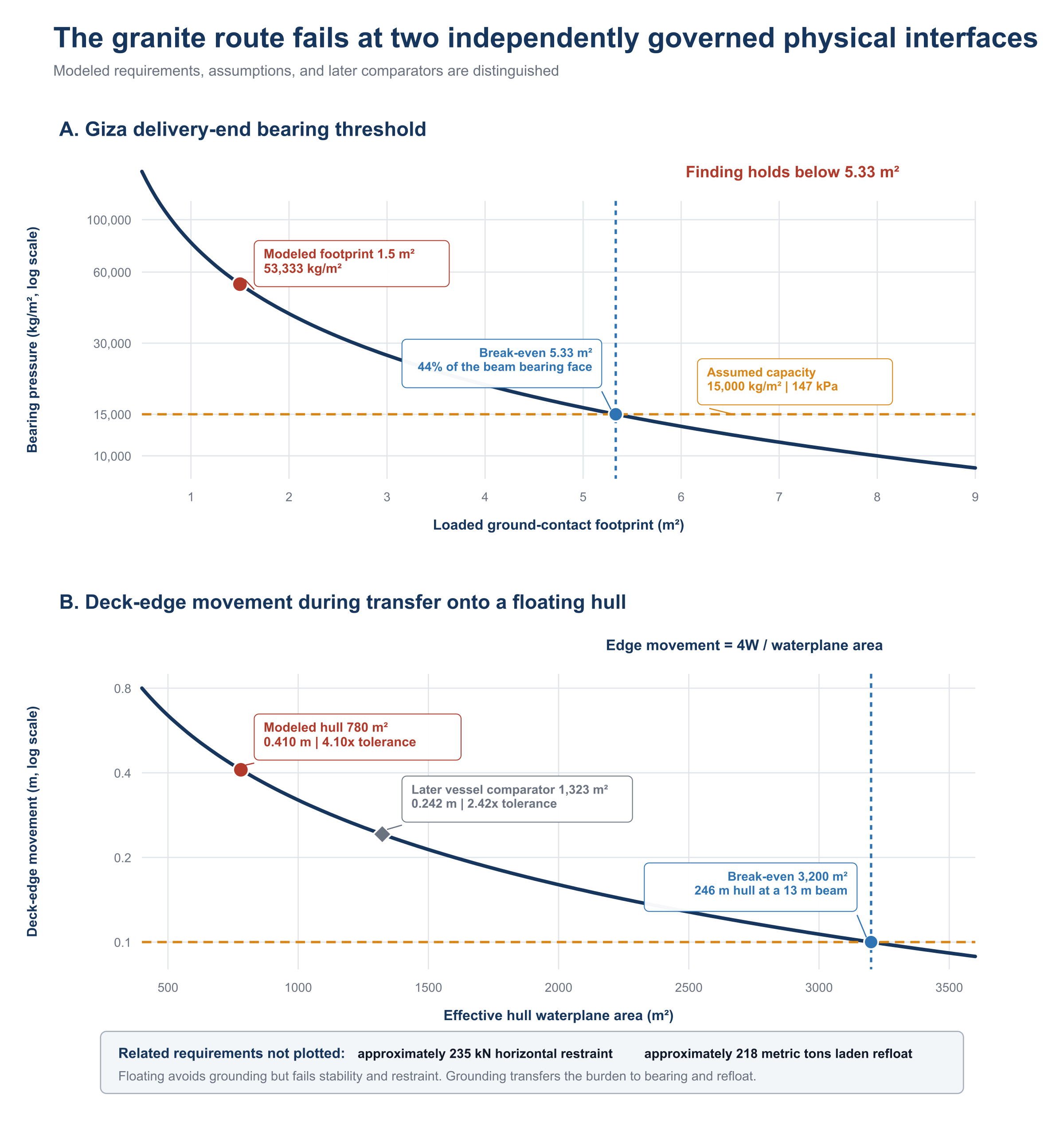
Figure 4. The granite route encounters two independent physical gates. For delivery-end bearing, the modeled 1.5 square meter footprint produces 53,333 kilograms per square meter against an assumed 15,000 kilogram-per-square-meter capacity; break-even requires 5.33 square meters. For floating transfer, the modeled 780 square meter waterplane produces 0.410 meter of deck-edge movement, 4.10 times the tolerance; a later 1,323 square meter comparator still produces 0.242 meter, or 2.42 times tolerance. Break-even requires 3,200 square meters.
Source: Research report v1.0, Section 6.8; White Paper v3.9 (wp39), Findings F30-F31; reported model transport and transfer calculations. The 15,000 kilogram-per-square-meter bearing capacity and 0.10 meter movement tolerance are assumptions; the 1,323 square meter vessel is a later comparator. Related approximately 235 kN restraint (24 metric tons-force) and approximately 218 metric tons laden-refloat requirements are not plotted.
6.9 What fails and what would reverse it
No single adjustment reverses these results because the failures are governed by different evidence and different physical requirements. The table identifies each controlling result and what a successful correction must demonstrate.
| Finding | Result | What would reverse it |
|---|---|---|
| Non-farm labor | 61.6% of the available pool; 2.5x the benchmark | A sourced demographic and state-capacity case supporting the required sustained share, or a fully burdened schedule that reduces concurrent demand |
| Demographic duration | 12.3% of every maturing male cohort; 0.825-1.140× Weni held continuously | Evidence of comparable sustained mobilization or a schedule that removes the standing demand |
| Settlement/workforce screen | 47,316 on-site roster vs 4,200 effective workforce; 11.27x on the published cumulative-roster basis and 8.35x in the MR-21 corrected-basis derivative; break-even capacity 47,316 effective workers (equivalent to 281,643 implied residents vs 25,000 screen) | Supported accommodation and distributed services for 47,316 effective workers, or a fully burdened schedule that reduces the on-site roster below that capacity |
| Timber | 30.09× the largest documented delivery over the build; 15.05× literal imported requirement at 50% import | A sourced reduction in demand, longer defensible service life, use-class supply, or delivery system at the required cumulative scale |
| Rope | 567.2 metric tons/year; 17.45 first-rate riggings/year | Lower supported consumption and replacement or a demonstrated fiber-production system at the required rate |
| Copper | 7.16x Bir Nasib long-run annual output; 11.01% of all-time output over the build | A source and smelting system at the required annual scale or lower supported tool loss |
| Granite bearing | Break-even lifting footprint 5.33 m² at Giza | A larger loaded footprint or demonstrated prepared bearing surface |
| Granite stability | 0.410 m movement; 4.10× tolerance; 3,200 m² break-even waterplane | A transfer method that avoids the moving edge or a hull above the waterplane threshold |
| Granite restraint and refloat | Approximately 235 kN restraint (24 metric tons-force); approximately 218 metric tons laden refloat | Defined, attested, and fully burdened restraint and recovery mechanisms |
Source: Research report v1.0, Sections 6.1-6.8; White Paper v3.9 (wp39), Findings F24-F31; Integrated Constructibility Model v0.92. Values retain their stated sourced, derived, assumed, diagnostic, or open status.
7. Every Failure Must Be Resolved
The findings share workers, materials, transport, land, and support, but they fail for different reasons. Increasing the population can expand the labor pool. It cannot create timber, copper, fiber, settlement capacity, vessel waterplane, prepared bearing, restraint, or refloat capability. A larger vessel can reduce deck-edge movement. It does not reverse the labor, settlement, timber, rope, or copper failures. A longer schedule lowers annual output while extending maintenance, replacement, and support.
The conventional explanation fails when any indispensable operation has no working method or exceeds the capacity available to sustain it. A correction receives every measured benefit and carries every labor, material, equipment, maintenance, time, and support requirement it creates. Correcting one failure cannot stand in for correcting another.
8. Adversarial Tests and Favorable Concessions
The model tests the strongest recurring attempts to rescue the construction explanation. It enlarges the labor pool, releases more men from agriculture, concentrates work into shorter seasons, permits imported and reassigned labor, doubles plank life, credits timber waste, disperses production away from Giza, and tests alternative granite operations. Each proposal receives the reduction it actually produces. None reverses all governing failures.
8.1 Population and available labor
The first attempted labor rescue is a larger available workforce. The sensitivity test varies the national population from 1.6 to 2.5 million, the prime-age male share from 20% to 30%, and the share reserved for agriculture from 85% to 65%.
At the sourced 1.6 million population anchor, every tested combination exceeds the model's 25% single-project benchmark. Even the most favorable combination, with 30% of the population classified as prime-age males and only 65% reserved for agriculture, requires 28.2% of the remaining non-farm pool.
At 2.0 million, two extreme combinations fall below the benchmark, at 24.2% and 22.5%. Both require independently favorable assumptions to occur together, and neither has a sourced Old Kingdom demographic basis. Evidence supporting either configuration would justify a complete rerun of the labor, food, household, and related support calculations. It would not change the timber, rope, copper, settlement, or granite thresholds.
The 25% benchmark is a stated project comparison, not a documented historical ceiling. Changing it does not change the modeled requirement. At the 1.6 million anchor, the construction program still requires 61.6% of the entire non-farm prime-age male labor pool. Evidence that the state could sustain 35% or 40% on one project would raise the comparison but would leave the project above it. Reversal on this front requires evidence that the state could sustain the full required share while continuing every other essential function.
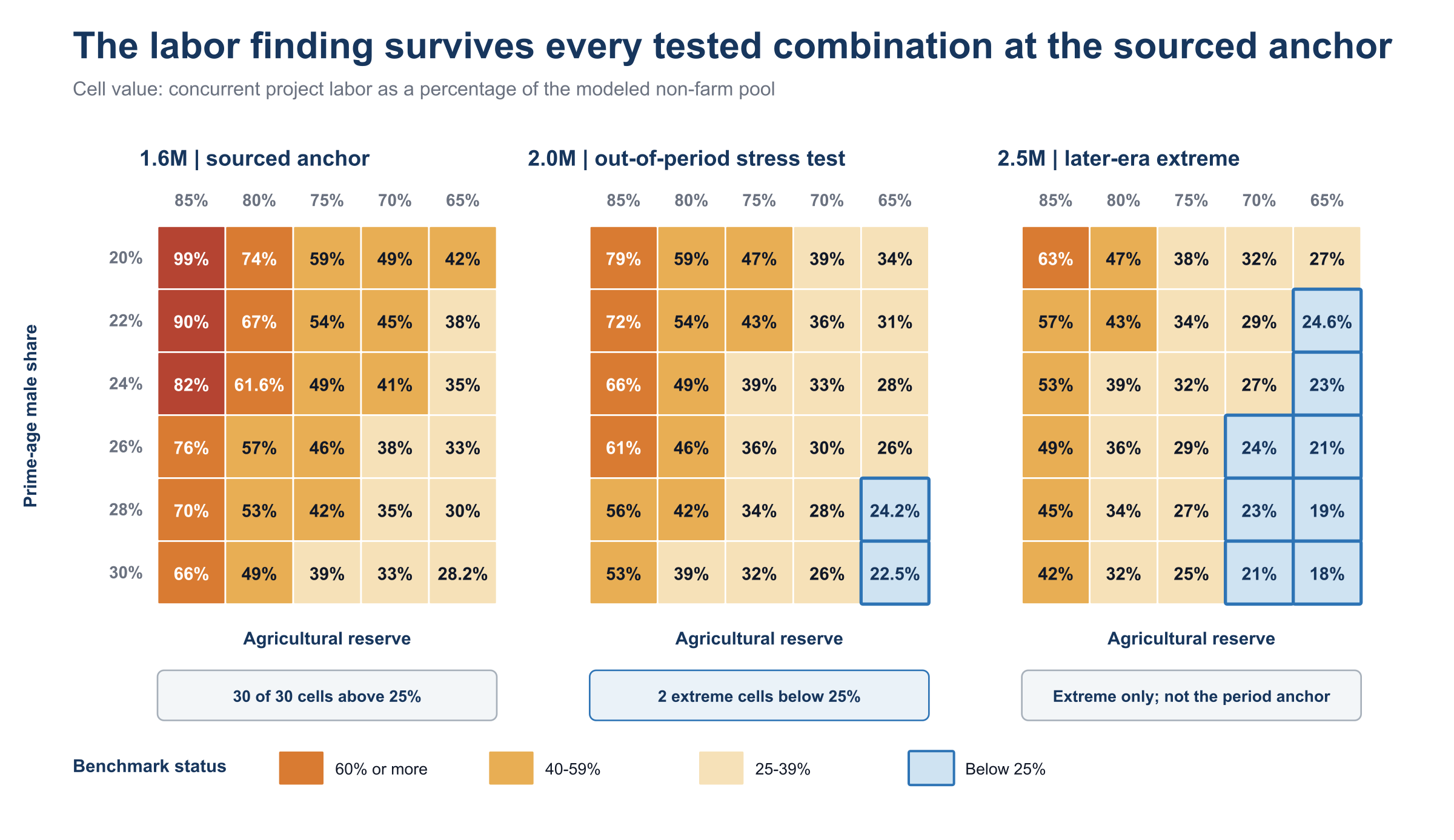
Figure 5. Concurrent project labor as a percentage of the modeled non-farm pool across tested demographic assumptions. All 30 combinations at the sourced 1.6 million population anchor remain above the 25% benchmark; the default cell is 61.6% and the lowest anchor cell is 28.2%. Only two cells in the 2.0 million out-of-period stress test fall below 25%. The 2.5 million panel is a later-era extreme, not the period anchor.
Source: Research report v1.0, Section 8.1; White Paper v3.9 (wp39) sensitivity analysis; reported model reference ClosureSensitivity_45. Prime-age male shares and agricultural reserves are tested assumptions. Population status is labeled by panel.
8.2 Seasonal labor and a shorter working season
The seasonal labor argument concentrates construction into the annual flood season. Seasonal labor does not remove the work. It requires the same output to be produced in less time.
Compressing a 20-year program into a three-to-four-month working season requires approximately three times the construction rate during those months. The available work area shrinks as the pyramid rises, while traffic density, ramp access, placement sequence, and competition with river delivery limit how far the rate can increase.
A mixed seasonal and rotating schedule remains testable. It must identify which departments rotate, when they rotate, how trained functions remain available, how river and agricultural peaks interact, and whether the resulting schedule preserves the required output. Any reduction in labor must also be carried through housing, food, water, equipment, maintenance, and support. The model can test such a schedule once those requirements are fully defined.
8.3 Importing or reassigning workers
Imported workers can reduce the number drawn from the domestic labor pool. They do not arrive without requirements. Their food, water, housing, transport, tools, supervision, and settlement burdens remain part of the construction program.
Reassigning soldiers to barges, harbors, or construction crews changes their department but does not increase the national body count. Counting additional groups as available construction labor also requires accounting for the agricultural, textile, processing, caregiving, and other work they were already performing. Labor becomes available to the project only when the displaced function is also reassigned or otherwise supplied.
8.4 Longer timber life and waste reuse
The model grants timber two substantial advantages. The plank-life multiplier is increased to 2.0, giving every plank a second complete service life through reuse, flipping, or downgrading. The corresponding timber and labor requirements receive the full reduction.
Waste timber is also credited against modeled fuel demand at 75%. That credit is capped so the same wood cannot be used twice.
Under these concessions, annual timber throughput can fall below the Palermo Stone comparison. The cumulative requirement across the build remains 17.48 times the recorded delivery. Longer plank life can reverse the annual comparison. It does not remove the build-long procurement and delivery burden.
8.5 Moving production away from Giza
Moving production away from Giza changes where the work occurs. It does not change what the construction program consumes.
Fiber farms, ropeworks, copper mines, charcoal production, timber crews, vessel yards, food producers, and transport organizations remain committed to the project when their output is required for construction. Dispersing them can reduce the concentration of people at Giza. The same labor, land, materials, transport, and production capacity remain assigned to the project.
8.6 Changing the granite route
Granite alternatives change how the route is attempted. They do not remove the need to load, carry, unload, and deliver the beams to the west-bank plateau.
End-loading and side-loading produce the same deck-edge movement. A larger hull reduces that movement only after it crosses the 3,200-square-meter effective-waterplane threshold. It must also carry its own timber, construction labor, crew, harbor, restraint, repair, and recovery requirements.
Grounding the vessel removes the instability of a floating loading operation but activates ground-bearing, restraint, and refloat requirements. A prepared unloading surface at Giza can reverse the bearing failure if its location, capacity, construction, and required resources are demonstrated.
An overland route does not eliminate the river crossing. The beams must still reach the west-bank plateau, requiring a defined route and working mechanism for loads between 50 and 80 metric tons. Each alternative can be tested once its complete operation and consequences are specified.
9. Discussion
9.1 What the findings establish
The conventional construction explanation is assembled from isolated demonstrations. Its supporting literature does not require the major operations to pass their own full-scale tests or the entire build to work as one project. This audit applies both tests. Several operations fail independently, and the complete project fails as well.
Labor and settlement fail within the complete program. Timber, rope, copper, and granite loading and unloading fail under separately governed material and physical tests. A correction to one governing input does not reverse failures controlled by different evidence or physical limits.
Rejecting the conventional explanation does not require a complete alternative history. It stands or falls on whether its own required operations can be performed and sustained. They cannot under the evidence, methods, and conditions tested here.
9.2 Why published parts do not form a construction program
Egyptology supplies the chronology, texts, institutions, and conventional construction explanation. Archaeology supplies the material record. Experimental archaeology tests individual operations. Engineering studies test forces, geometry, materials, production rates, and physical limits. No published study reviewed here makes all of that work operate as one project.
Specialization is not the failure. The failure begins when a successful test of one operation is treated as support for the entire build without restoring the project requirements that the test excluded. A hauling experiment does not establish the crews, replacement equipment, route capacity, maintenance, food, water, housing, and support required to sustain output. A vessel reconstruction does not establish loading stability, restraint, ground bearing, unloading, or refloat.
9.3 What modern project controls can and cannot do
Modern project-control and construction-sequencing tools can test a defined project. Oracle Primavera P6 can schedule activities and resources (Oracle 2026). ALICE can generate and compare construction sequences from stated production rates, resources, and constraints. Four-dimensional construction platforms, discrete-event simulators, and system-dynamics tools can examine other parts of program behavior.
These tools begin after the project has been defined. The Great Pyramid problem begins earlier. No complete project record survives, so the activities, dependencies, production requirements, material systems, support functions, and physical interfaces must first be reconstructed from incomplete historical evidence.
Quantifying Antiquity performs that reconstruction, then extends the analysis beyond scheduling into national labor availability, agriculture, household support, material depletion, replacement across decades, off-site production, and physical capability. No standard construction application supplies that complete combination.
The calculations do not depend on proprietary scheduling rules. A P6 or ALICE implementation could independently test the activity logic and resource-constrained sequence after the full project definition has been entered. It would still require the same labor, materials, production rates, support requirements, feedback relationships, and physical thresholds. Scheduling software can rearrange defined work. It cannot create resources absent from the evidence or supply a missing construction mechanism.
9.4 The burden of technical response
The next technical burden lies with anyone defending the conventional explanation: identify an error in the published record, provide sourced inputs that clear a governing threshold, or provide a complete working method and carry its labor, materials, equipment, maintenance, time, and support through the same project.
Engineering results do not depend on institutional approval. Journal acceptance cannot make an unworkable operation work, and academic acceptance cannot supply a missing resource or mechanism. Non-response does not reverse a finding. The findings remain until the published record is broken at a load-bearing point.
9.5 What the method contributes beyond the Great Pyramid
The method can be applied to other ancient large structures, but the findings cannot be transferred automatically. Every project requires its own construction sequence, evidence base, material system, workforce structure, environmental conditions, and capacity limits.
What transfers is the audit discipline: define every required function, connect its dependencies, preserve shared-resource limits, calculate replacement and support across the project life cycle, test physical interfaces, and compare the complete program with the capacity available at the time.
10. Limitations, Reversal Conditions, and Open Work
10.1 What the model cannot know directly
No complete construction record survives for the Great Pyramid. The audit therefore combines sourced evidence, derived quantities, and stated assumptions. Each input is classified and exposed so that its role can be examined and changed.
The demographic calculation depends on a hypothetical population anchor, a derived prime-age share, and an agricultural reserve. The material calculations depend on service lives, conversion losses, production yields, tool wear, ore grade, charcoal demand, and labor productivity. The granite calculations depend on ground conditions, transfer tolerance, vessel dimensions, and the configuration of the loading and unloading operations. These inputs do not carry equal confidence, and the model does not present them as if they do.
The current schedule holds several support functions active during the periods in which they are required. A more detailed construction schedule could stagger some of that labor. Any reduction would have to preserve production output and carry the resulting handoffs, seasonal restrictions, resource conflicts, maintenance, replacement, and extended support. A schedule that lowers staffing at one point can increase duration or demand elsewhere.
Route congestion, passing, counterflow, final ramp access, some casing work, mortar and gypsum fuel, administration, security, lighting, sanitation, medical support, and several other required functions remain incomplete. Where they represent additional work, their omission favors the conventional explanation because they currently add nothing to the reported burden.
The 25% labor benchmark is an assumed project comparison, so the direct requirement of 61.6% is reported beside it. The Palermo Stone delivery and Bir Nasib production are documented scale comparisons, not proven national capacity ceilings. The Giza bearing result depends on the actual capacity and preparation of the unloading surface. The vessel comparison uses a later, contested, and deliberately favorable hull. These limits define what each result means. They do not erase the measured requirements.
10.2 What would reverse the findings
A falsifiable finding states what evidence or physical performance would change it. The following evidence could reverse or materially alter specific results:
- A sourced demographic configuration that produces a substantially larger non-farm labor pool while preserving agriculture and every other required state function.
- A complete seasonal-labor, rotating, or staggered schedule that maintains the required construction output, reduces the workforce required during the same operating period, and carries the resulting infrastructure, maintenance, material, and support demands.
- Archaeological evidence for settlement or distributed accommodation at the workforce scale required by the model, together with the services needed to sustain it.
- Supported timber service lives, use assignments, processing losses, domestic structural supply, or delivery capacity sufficient to reduce the full project-life procurement requirement.
- Lower supported rope consumption or longer rope service life while preserving the required haulage, restraint, and safety functions.
- An Old Kingdom copper source and smelting system capable of supplying the required annual production, or supported tool-loss rates low enough to bring that requirement within the demonstrated supply.
- A prepared unloading surface at Giza with sufficient bearing capacity and documented construction, materials, labor, and location.
- A vessel or loading and unloading method that either provides at least 3,200 square meters of effective waterplane or avoids crossing a moving deck edge.
- Working and dimensioned loading, restraint, grounding, refloat, repair, unloading, and heavy-haul mechanisms whose materials, labor, equipment, and support can operate within the same construction program.
A change propagates through every calculation it affects, but it reverses only the findings whose governing thresholds it clears. The conventional explanation becomes viable only when every required operation has a working method and the complete program fits within the available schedule, resources, support capacity, and physical limits.
10.3 Open work does not suspend the result
Open functions remain in the audit record for completeness and traceability. Sanitation, medical support, processing, containers, administration, security, lighting, route congestion, and other incomplete functions currently contribute zero to the result. Completing them may refine a quantity, reveal an overlap, or add further burden.
None currently supplies the timber delivery capacity, copper production, rope service life, settlement evidence, bearing area, vessel waterplane, restraint, or refloat capability required to reverse an established finding. Removing an established requirement requires evidence that the function is unnecessary or a fully specified replacement that performs the same work and carries its own consequences. Until then, the established failures control the result.
11. Conclusion
The conventional construction explanation fails on several independent fronts. Labor and settlement exceed the comparisons used in the audit. Timber, rope, and copper fail separate supply tests. Granite transport fails at bearing, floating transfer, restraint, unloading, and refloat.
The explanation also fails as a complete building program. Its required operations do not fit within the same schedule, workforce, materials, transport system, support structure, and physical limits.
The labor requirement reaches 61.6% of the modeled non-farm prime-age male labor pool. The on-site roster is 11.27 times the effective workforce underlying the settlement screen on the workbook’s published cumulative-roster basis and 8.35 times that screen in the corrected-basis derivative recorded in MR-21. Timber throughput reaches 30.09 times the largest documented delivery across the build. Annual rope replacement reaches 567.2 metric tons. Quarry-tool copper requires 7.16 times Bir Nasib’s estimated long-run average annual output.
The granite route fails at loading and unloading. Loading an 80-metric-ton beam moves the modeled vessel’s deck edge 4.10 times the stated tolerance. Break-even requires 3,200 square meters of effective waterplane. Even the largest attested Egyptian vessel permits 0.242 meters of deck-edge movement, 2.42 times the tolerance. Grounding the vessel replaces that instability with bearing, restraint, and refloat requirements for which the conventional explanation supplies no complete working method.
The audit determines that Old Kingdom Egypt did not possess the capability required to deliver the Great Pyramid. Reversal requires evidence that clears every governing threshold or a fully defined construction program that supplies every required mechanism and carries its labor, materials, infrastructure, maintenance, time, and support through the same finite schedule and resource base. Until that occurs, the conventional explanation does not close under the tested conditions.
Data, Model, and Transparency Statement
Checking the Model Yourself
The public Quantifying Antiquity application at https://model.quantifyingantiquity.com exposes the principal load-bearing inputs and controls used by the audit. Readers can change those controls, run the model, and export a scenario receipt.
A scenario receipt is a readable document that records the assumptions entered and the baseline values they replaced; the headline closure results; every registered output that changed, with its baseline and scenario value; the workbook and engine identifiers; the source register supporting the inputs; and the generation time.
Each receipt contains a scenario digest: a SHA-256 fingerprint of its canonical technical scenario content. Re-running the same resolved inputs on the same released model produces the same digest. A reviewer can therefore set the same controls, export a fresh receipt, and compare the digest with the scenario being checked.
Each download also includes a separate .sha256 file covering every byte of that particular receipt, including its generation time. It detects whether that copy has changed. The checksum must be separate because a file cannot contain a checksum of itself.
These hashes are checks, not signatures. They are generated without a secret, so anyone can edit a receipt and calculate consistent new hashes. They do not prove where a receipt came from. The baseline receipt and its whole-file checksum released with this edition are deposited with the companion WP39 record at https://doi.org/10.5281/zenodo.22392247. Readers can therefore confirm that a copy matches the independently timestamped deposit; that added assurance comes from the archive record, not from the hash alone.
Quantifying Antiquity White Paper v3.9 (wp39) documents the evidence base, model structure, governing equations, findings, limitations, and reversal conditions. Integrated Constructibility Model v0.92 is the controlling numerical record for this paper.
The controlling workbook is protected intellectual property and is not offered as a public download. Its implementation is proprietary. The receipts do not let readers reconstruct or independently recompute the workbook. They provide a narrower form of reproducibility: readers can re-run disclosed inputs on the public model, confirm the scenario digest, and inspect every registered value that moved. The published record provides the methods, equations, input definitions, comparisons, reported outputs, source support, and reversal conditions required for technical examination and challenge.
Quantifying Antiquity does not publish its controlling workbook. The reproducibility claim is therefore limited to the disclosed methods, public model, scenario receipts, registered outputs, archived release artifacts, and independently available source materials used by bounded modules within the audit.
Workbook cell references identify locations in the protected controlling record for audit and version control. Because the workbook is not publicly distributed, these references are provenance locators rather than a substitute for publicly stated inputs, calculations, and results. Headline outputs are traceable to the controlling workbook: the concurrent labor share to ClosureSensitivity_45!B38; the on-site roster and implied village to Model_04!C122 and B123; the broader project population to Model_04!B134; the lower and upper food treatments to FoodFeedback_28!B14:B16 and B54; timber to TimberLabor_40!B7; rope to Model_04!B94:B95; copper to Model_04!B65:B66; and the principal granite thresholds to GraniteAswan_42!B48 and SensitivityBreakEven_06!B11 and B22. The granite bearing-face comparison is traced through Inputs_03!B195:B196, GraniteAswan_42!B20:B21, and SensitivityBreakEven_06!B11.
Three reported quantities are calculated in this paper from named workbook values rather than read from single output cells: 550.7 metric tons of copper is Model_04!B51 multiplied by the 20-year build duration in Inputs_03!B81; approximately 235 kN of restraint is GraniteAswan_42!B53 converted from metric tons-force using 9.80665 kN per metric ton-force; and 44% of the beam’s bearing face is SensitivityBreakEven_06!B11 divided by the product of Inputs_03!B195 and Inputs_03!B196. The 8-by-1.5-meter bearing face is an exposed approximation. The governing bearing finding compares the modeled 1.5-square-meter lifting footprint directly with the 5.33-square-meter break-even footprint and does not depend on the 44% expression.
The 9.86-times and 8.35-times settlement ratios and the 403,746 broader-population figure are measured derivatives recorded in MethodsRulings_48!E49 (MR-21). They are not live output cells.
Version 0.92 is the controlling release. The paper’s reported figures were reconciled figure by figure against v0.90; v0.91 and v0.92 add text repairs that moved no reported value. The figures and findings in this paper are current against v0.92.
This paper's permanent Zenodo record is https://doi.org/10.5281/zenodo.22390422. The companion technical report and its supporting release artifacts, including the receipt specification, baseline receipt, reference checking script, release manifest, and checksums, are archived with WP39 at https://doi.org/10.5281/zenodo.22392247. For corrections and later versions, use the Versions section of the applicable Zenodo record.
Competing Interests
Quantifying Antiquity declares no competing interests.
References
- Abdel-Motelib, A., et al. 2012. Study of the archaeometallurgical remains at Bir Nasib, Sinai. Metalla 19(1/2).
- Butzer, Karl W. 1976. Early Hydraulic Civilization in Egypt: A Study in Cultural Ecology. Chicago: University of Chicago Press. See p. 83, table 4.
- Hemeda, Sayed, and Alghreeb Sonbol. 2020. "Sustainability Problems of the Giza Pyramids." Heritage Science 8:8. https://doi.org/10.1186/s40494-020-0356-9.
- Lehner, Mark. 2002. "The Pyramid Age Settlement of the Southern Mount at Giza." Journal of the American Research Center in Egypt 39: 27-74. https://doi.org/10.2307/40001149.
- Lehner, Mark. 2015. "Labor and the Pyramids: The Heit el-Ghurab Workers Town at Giza." In Labor in the Ancient World, 397-522.
- Lehner, Mark. 2020. "Lake Khufu: On the Waterfront at Giza." In Profane Landscapes, Sacred Spaces, 191-292. Equinox.
- Oracle. 2026. Primavera P6 Professional User Guide, version 26. https://docs.oracle.com/cd/G48902_01/English/User_Guides/p6_pro_user/toc.htm.
- ALICE Technologies. 2026. "Construction Optioneering," "Constraints and Milestones," and "Material Resources."
- Redding, Richard W. 2013. "A Tale of Two Sites: Old Kingdom Subsistence Economy and the Infrastructure of Pyramid Construction." In Archaeozoology of the Near East X, 307-322. Peeters.
- Rosell Roig, Vicente Luis. 2026. "A Computational Framework for Evaluating an Edge-Integrated, Multi-Ramp Construction Model of the Great Pyramid of Giza." npj Heritage Science 14:142. https://doi.org/10.1038/s40494-026-02405-x.
- viroroi-pub and viroroi. 2026. viroroi-pub/Egypt: Integrated Edge-Ramp 1.0.14. Version v1.0.14. Zenodo. https://doi.org/10.5281/zenodo.20615955.
- Tallet, Pierre. 2017. Les papyrus de la mer Rouge I: Le Journal de Merer. MIFAO 136.
- Tallet, Pierre, and Mark Lehner. 2022. The Red Sea Scrolls: How Ancient Papyri Reveal the Secrets of the Pyramids.
- Wilkinson, Toby A. H. 2000. Royal Annals of Ancient Egypt: The Palermo Stone and Its Associated Fragments. London: Kegan Paul. See pp. 141-145.
- Younes, Gamal, et al. 2024. "The Pyramid Builders' Waterways: Reconstructing the Ancient Topography of Khufu's Pharaonic Harbour at Giza, Egypt." Journal of Archaeological Science: Reports 53:104303. https://doi.org/10.1016/j.jasrep.2023.104303.
- Lichtheim, Miriam. 2006. "The Autobiography of Weni." In Ancient Egyptian Literature, Volume I: The Old and Middle Kingdoms, 18-22. Berkeley and Los Angeles: University of California Press.